Anastasiia Saveleva at OVERTIME 26: REDUX — Three Works About What Keeps an Object in Someone’s Life
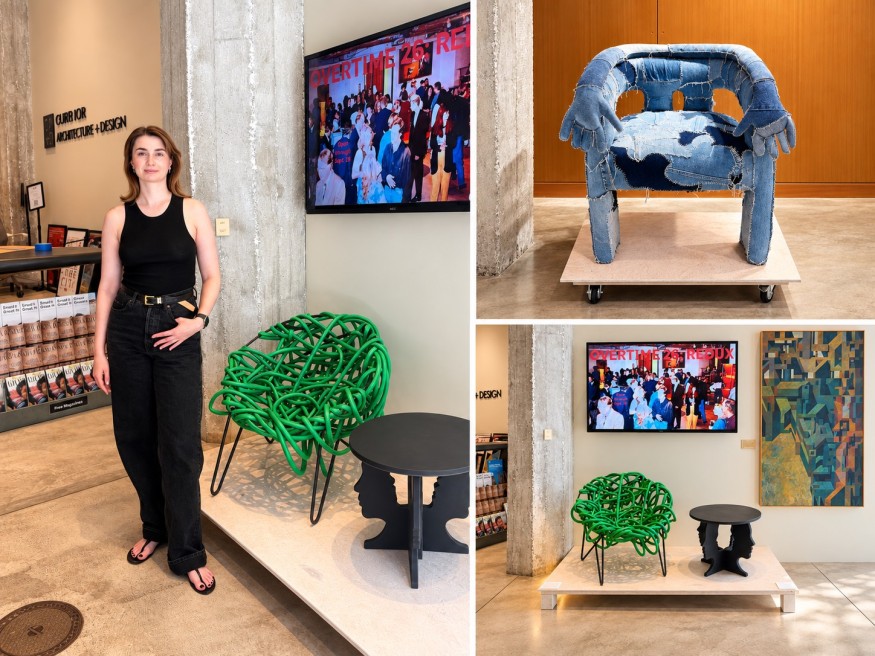
The Los Angeles designer brought three pieces to San Francisco: a chair made of old denim, hand-stitched over three months; the Two-Face Coffee Table, a recycled-plywood object that earned her the title of the country's best art designer; and an armchair woven from a retired garden hose. Three objects, three versions of the same argument.
The Emotional Support Chair is hard to walk past. Its arms open outward and end in soft shapes that read as palms. The surface is assembled from dozens of patches of worn denim — pale and dark — joined by visible hand stitching; the darker fabric spreads across the seat like a deliberate stain. The chair is the work of Anastasiia Saveleva, an interior and furniture designer based in California. At OVERTIME 26: REDUX, the exhibition at San Francisco's Center for Architecture + Design, it is one of three pieces of hers on view — and arguably the most tactile of them.
Saveleva is the founder of the Los Angeles studio DSGNSIA, which works at the intersection of interiors and collectible furniture. Her recognizable register is soft brutalism: heavy, grounded geometry, but with a tactility, warmth, and emotional note that classic concrete austerity lacks. The studio makes sculptural furniture and textile objects in small and single editions, takes on residential interiors, and works on principle with reused materials, turning what has been written off into functional things. Her work has been shown in Los Angeles, Miami, and San Francisco, and her record includes a run of awards: in December 2025 she was named a laureate of the international Travel to Art Award in the Best Furniture Designer category (the ceremony was held in Miami, at Millecento by Pininfarina, during Art Basel week), and in the spring of 2026 she won the Russian national Best Talents award in the Best Art Designer category.
There is a worked-out theory behind the practice. Saveleva is the author of a methodology she calls Soulcraft: a system of emotionally conscious sustainable furniture and interior design. It brings together three lines that usually live apart — the circular economy (reuse, repairability, disassembly), biophilic design, and the idea of emotionally durable objects. The founding thought is simple and inconvenient for the industry: things are discarded not only when they break, but when they stop meaning anything. Which means material reuse and emotional attachment have to be designed at the same time — otherwise neither durability nor sustainability will save the object. The methodology has been developed into a working instrument: stages, rating scales, material and object passports, and a requirement to document the provenance of every material — the mechanism that separates real sustainability from marketing rhetoric.
Giving Denim Its Biography Back
This is where material stops being background and becomes content. The Emotional Support Chair is made entirely of recycled denim — post-consumer fabric that at most manufacturers would have gone to waste — and was hand-stitched over roughly three months. That span is visible in the object: the seams are left raw and frayed, the patches meet along an overcast stitch, and nothing pretends to be light or machine-made. The patchwork works as both structure and narrative: each piece of denim carries its own history of wear, and together they build a surface that reads as a biography rather than upholstery. Soft but composed, the chair holds its shape and still invites you to settle into it — a tactile shelter in which the stored energy of old fabric matters more than the shine of the new.
Hence the name. Saveleva means "emotional support chair" seriously: three months of labor, the shared history of worn fabric, the almost anthropomorphic arms reaching toward whoever sits down — all of it moves comfort out of the spec sheet and into something accumulated over time and left visible. Here, care and reuse are inseparable.
A Table That Changes While You Walk Around It
Next to it on the plinth stands an object of an entirely different temperament — the Two-Face Coffee Table. Black, oval, with legs cut in the shape of human profiles: two faces looking in opposite directions, holding the tabletop between them. It looks minimal right up until you take a step to the side.
That is the whole idea. The table is a transformer with no mechanism at all — no folding elements, no hidden hardware. "Change can happen not through the complexity of the construction, but through form, proportion and the movement of the person around the object," Saveleva explains. Simply turning it ninety degrees completely changes how the piece is perceived: today the owner sees one thing, tomorrow another, and refreshing the room is a matter of repositioning the table.
The material is as deliberate as the denim chair's: recycled plywood, CNC-milled. The project exists in a single copy. It is what earned Saveleva first place in the Best Art Designer category at the fifth national Best Talents award in April 2026, held at the St. Petersburg Chamber of Commerce and Industry: the organizing committee received more than 2,500 entries from over 40 cities, and in her category alone she was up against more than 50 contenders. The jury cited four things at once — originality (a transformer without mechanics), the exceptional standing of the author, innovation (secondary raw material as the basis of authored design), and creativity: here the table is not only a utilitarian object but an element that sets the character of a space. Before San Francisco, the piece was shown at the AAU Spring Show 2026 and at an exhibition in Miami.
An Armchair Made from a Garden Hose
The third work on the plinth is the loudest in color. The bright green armchair is woven from a retired garden hose: flexible loops thrown loosely over one another form a dense nest set on thin black metal legs. Nothing soft, nothing sewn — only a springy structure that holds a person on its own.
The material belongs squarely to the category of things that go to landfill without comment: nobody repairs a garden hose or takes it to be recycled; it is simply thrown out once it stops holding water. Saveleva gives it back its one remaining virtue — resilience — and builds a form out of that. The color stays as it was, the cuts and bends are not concealed, and the chair states plainly what it is made of. Alongside the denim and the plywood, this is a third register of the same thought: the material had a past, and there is no reason to hide it.
Seen together, the three works read as three answers to a single question — why should this object exist at all? The hose answers with structure, the plywood with optics and a ninety-degree turn, the denim with three months of hand stitching.
Why This Exhibition
Showing work like this at OVERTIME 26: REDUX makes sense. Since 1991, the OVERTIME series has been devoted to what architects and designers make when they are off the clock; it was revived by the Center for Architecture + Design, and the REDUX section (on view through September 19 at 140 Sutter Street) is given over to a new generation of authors. The Emotional Support Chair is also available for purchase through the Center, which is likewise in the spirit of an exhibition conceived as an honest showcase for the personal, unvarnished experiments of working designers.
Together, the three objects gather everything Anastasiia Saveleva does: rigorous selection and accounting of material, the craft patience of a hand-sewn seam, the precision of a digital mill, the aesthetics of soft brutalism, and the conviction that sustainable design begins not with a certificate but with the way you relate to an object you want to keep.
OVERTIME 26: REDUX is on view at the Center for Architecture + Design (140 Sutter Street, San Francisco) through September 19, 2026. Anastasiia Saveleva's works — the Emotional Support Chair, the Two-Face Coffee Table, and the armchair made of recycled garden hose — were presented by the Center as part of its exhibition-artist series.


Is Your Wall Paint Looking Dull? Here's Why It Happens and How to Bring Your Walls Back to Life

Inside Madrid's Brand-New F1 Circuit: The Designer Explains the Dramatic Ideas Behind the Madring

MAD's Lucas Museum Is Set to Open in Los Angeles on September 22

The Basement Is Getting a Design Makeover, and It's No Longer Just for Storage

French Windows Never Really Went Out of Style—Here's Why Designers Still Love Them


